Category: Hazard Communication Plan

  • Hazard Communication Program – Example

    Hazard Communication Program – Example

    According to OSHA, the purpose of the Hazard Communication Standard is “to ensure that the hazards of all chemicals produced or imported are evaluated and details regarding their hazards are transmitted to employers and employees.” The purpose behind the HAZCOM standard is that employers and employees have the right to know the hazards and identities of the chemicals they are exposed to and what precautions can be taken to protect themselves.

    All companies have a requirement to comply with the HAZCOM standard, even if it is as simple as using cleaning chemicals.

    Categories within the OSHA Hazard Communication Standard:

    Hazard Classification

    The first category, Hazard Classification (29 Code of Federal Regulations (CFR) 1910.1200 (d)) requires chemical manufacturers and importers to evaluate the chemicals produced in their workplaces or imported by them to determine the hazard classes, and, where appropriate, the category of each class. Mandatory classification considerations are given in 29 CFR 1910.1200 Appendix A (Health Hazard Criteria) and Appendix B (Physical Criteria).

    Written HazCom Program

    The second category is the Written Hazard Communication Program (29 CFR 1910.1200(e)). It requires employers to fully document the actions taken to comply with all of the provisions of the Hazard Communication Standard and to list the responsible person(s) for each area of the program. A copy of the written program must be made available, upon request, to all employees and OSHA officials.

    Check Out: Hazard Communication Plan Explained

    Labels and other Forms of Warning

    The third category, Labels and other Forms of Warning (29 CFR 1910.1200(f)), requires chemical manufacturers, importers or distributors to ensure that each container of hazardous chemicals leaving their workplace is labeled, tagged or marked to GHS standards.

    The GHS is a global hazard communication system developed by the UN that standardizes the way hazardous chemicals are classified and then communicated via safety data sheets and labels.

    GHS compliant labels now have six standardized elements:

    1. product identifier,
    2. signal word,
    3. precautionary statements,
    4. hazard statements,
    5. manufacturer information,
    6. pictograms.


    Safety Data Sheets

    The fourth category, Safety Data Sheets (SDSs) (29 CFR 1910.1200(g)) requires that chemical manufacturers, importers or distributors provide SDSs for each hazardous chemical to downstream users to communicate information on the hazards. All of the information on the SDS must be in English and be available to employees working with or near the hazardous chemical. SDSs are now presented in a consistent user-friendly, 16-section format.

    Sections of a SDS explained:

    1. Identification includes product identifier; manufacturer or distributor name, address, phone number; emergency phone number; recommended use; restriction on use.
    2. Hazard Identification includes all hazards regarding the chemical; required label elements.
    3. Composition information on ingredients include information on chemical ingredients; trade secret claims.
    4. First-aid measures include important symptoms/effects acute, delayed; and required treatment.
    5. Fire-fighting measures list suitable extinguishing techniques, equipment; and chemical hazards from fire.
    6. Accidental release measures list emergency procedures, protective equipment; proper methods of containment and cleanup.
    7. Handling and storage lists precautions for safe handling and storage, including incompatibilities.
    8. Exposure controls/personal protection list OSHA’s Permissible Exposure Limits (PELs); Threshold Limit Values (TLVs); appropriate engineering controls; and personal protective equipment.
    9. Physical and chemical properties list the chemical’s characteristics.
    10. Stability and reactivity list chemical stability and possible hazardous reactions.
    11. Toxicological information includes routes of exposure; related symptoms, acute and chronic effects and numerical measures of toxicity.
    12. Ecological information provides information to evaluate the environmental impact of the chemical(s) if it were released to the environment.
    13. Disposal considerations provide guidance on proper disposal practices, recycling or reclamation of the chemical or its container and safe handling practices.
    14. Transport information provides guidance on classification information for shipping and transporting of hazardous chemicals by road, air, rail or sea.
    15. Regulatory information provides guidance on classification information for shipping and transporting of hazardous chemicals by road, air, rail or sea.
    16. Other information includes the date of preparation or last revision.
    Check Out How to Read an SDS Sheet for more information

    Employee Information and Training

    The fifth category, Employee Information and Training (29 CFR 1910.1200(h)), requires employers to provide employees with effective information and training on hazardous chemicals in their work area at the time of their initial assignment and whenever a new physical or health hazard is introduced into the area. The training must include methods and observations used to detect the presence or release of the chemical, physical and health hazards, protective measures, labeling and explanation of the SDS.


    The OSHA Hazard Communication Standard, also known as HazCom, 29 CFR 1910.1200, is a U.S. regulation that governs the evaluation and communication of hazards associated with chemicals in the workplace.

    Download & view the Hazard Communication Program – Example below


  • Spill Response Plan – Training

    Spill Response Plan – Training

    Developing an effective Spill Response Plan involves a lot of planning and thinking ahead to manage the worst type of spill that could happen. Take it step by step and decide how to handle each problem. Then obtain the necessary supplies and train all employees in their use. Last, anticipate and plan for a disastrous spill or an event that would trigger the 911 call. Train all employees thoroughly.

    Developing A Spill Response Plan

    An effective Spill Response Plan requires:

    • A complete evaluation of the work site.
    • Make an emergency evacuation plan for the area, work site, or building.
    • List the chemicals that are stored on-site, as well as their amounts.
    • Determine what constitutes a small spill that can be safely controlled and cleaned up by on-site personnel.
    • Decide what is a ‘large spill’.
    • Decide what will trigger a 911 call or one for the Emergency Response Team or HAZMAT Team.
    • Plan the most effective way to handle any spill that might occur.
    • Develop a recommended Spill Response for each chemical that is on-site.
    • Determine the amount of Spill Kits and containment supplies that will be needed and have them on-site, near the chemical storage area.
    • Determine what Personal Protective Equipment (PPE) will be needed to manage a spill of each chemical.
    • Be sure there is an adequate amount off PPE on hand.
    • Train all workers in the proper use of PPE.
    • Be sure that there are adequate numbers of fire extinguishers on-hand and employees know how to use them.
    • Make a list of emergency phone numbers and post several in highly visible places.
    • Make a list which contains the phone numbers of individuals that are to be contacted in the event of a spill.This should be kept in an area that is easily accessed by all personnel.
    • If different chemicals are added to the on-site inventory, the amount or type of spill containment supplies may need to be increased.
    • Employees and contractors who come on site must all be trained in the Spill Response Plan and how to use spill containment supplies such as drain plugs, dikes and socks to help avoid a release of the spilled chemicals into the environment.
    • Determine reporting requirements to federal, state and local agencies.
    • Designate personnel or a manager to handle this task. Necessary reporting forms should be available on-site.
    • Obtain SDS sheets for all chemicals on site.
    • Have SDS sheets readily available for employee use; this can be in a binder or electronically, as long as employee’s know how to access them when needed.
    Check Out: How to Read an SDS Sheet

    Employee Training for Spill Response

    All employees and on-site contractors must be trained in:

    • Neutralizing and controlling chemical spills
    • Cleaning up hazardous wastes
    • How to use PPE
    • How to use a fire extinguisher
    • Basic First Aid
    • Management of used personal protective equipment (PPE)
    • Disposal of clean up materials
    • Disposal of hazardous waste
    • Handling the reporting requirements of state, federal and local agencies
    • Understanding the use of SDS Information Sheets
    • Understanding how to access SDS sheets in the company’s method of choice
    Check Out: Budgeting for Training

    Employees should be involved in the development of the Spill Response Plan and be able to recognize a spill that requires a 911 call. They should know the location of spill control supplies as well as spill kits. For the safety of all, every employee and contractor must be well trained and understand the Plan well.

    The below training can be given in a classroom presentation, or as part of a self-learning style. Just ensure your company has a subject matter expert to answer questions.

    Download & view the Spill Response Training below:


  • HCS Training for Supervisors

    HCS Training for Supervisors

    The  Hazard Communication Standard 2012 is now aligned with the United Nations Globally Harmonized System of Classification and Labeling of Chemicals (GHS) that provides many benefits, including:

    • Providing a common and coherent approach to classifying chemicals and communicating hazard information on labels and safety data sheets;
    • Improving the quality and consistency of hazard information in the workplace;
    • Helping reduce trade barriers;
    • Productivity improvements for American businesses that regularly handle, store, and use classified hazardous chemicals;
    • Providing cost savings for American businesses that periodically update safety data sheets and labels for classified chemicals.

    Historical note: The old HCS 1994 gave workers the right to know, but the HCS 2012 gives workers the right to understand: this is a very important change in OSHA’s approach.

    OSHA has defined the term “substances” as chemical elements and their compounds in the natural state or obtained by any production process, including any additive necessary to preserve the stability of the product and any impurities deriving from the process used, but excluding any solvent which may be separated without affecting the stability of the substance or changing its composition.

    For the purposes of the HCS, a hazardous chemical means any chemical which is classified as a physical hazard or a health hazard, a simple asphyxiant, combustible dust, pyrophoric gas, or hazard not otherwise classified.

    Physical hazards – a chemical that is classified as posing one of the following hazardous effects:

    • explosive
    • flammable (gases, aerosols, liquids, or solids)
    • oxidizer (liquid, solid or gas)
    • self-reactive; pyrophoric (liquid or solid)
    • self-heating
    • organic peroxide
    • corrosive to metal
    • gas under pressure or
    • in contact with water emits flammable gas

    See Appendix B to 1910.1200 — Physical Hazard Criteria.

    Health hazard – a chemical which is classified as posing one of the following hazardous effects:

    • acute toxicity (any route of exposure)
    • skin corrosion or irritation
    • serious eye damage or eye irritation
    • respiratory or skin sensitization
    • germ cell mutagenicity
    • carcinogenicity
    • reproductive toxicity
    • specific target organ toxicity (single or repeated exposure) or
    • aspiration hazard

    The criteria for determining whether a chemical is classified as a health hazard are detailed in 1910.1200, Appendix A – Health Hazard Criteria.

    HCS 2012 Pictogram Requirements

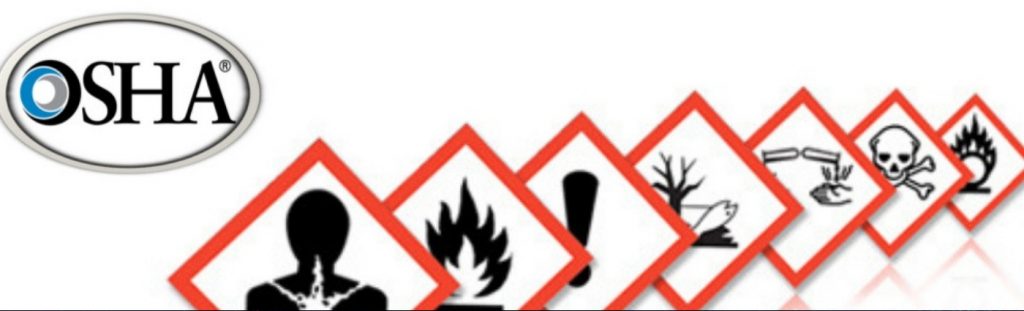
    The HCS 2012 requires GHS pictograms on labels to alert users of the chemical hazards to which they may be exposed. Each pictogram consists of a symbol on a white background framed within a red border and represents a distinct hazard(s). The pictogram on the label is determined by the chemical hazard classification.

    While the GHS uses a total of nine pictograms, OSHA will only enforce the use of eight. The environmental pictogram is not mandatory but may be used to provide additional information. Workers may see the ninth symbol on a label because label preparers may choose to add the environment pictogram as supplementary information.


    Under the HCS 2012, labels on containers shipped from manufacturers or distributors must be labeled, tagged or marked with the following six items:

    1. Product Identifier – This should include the chemical identity of the substance.
    2. Signal word – Signal words used in GHS are “Danger” and “Warning.” Danger is for the more severe hazard categories.
    3. Hazard Statements – This is a phrase assigned to a hazard class and category that describes the nature of the hazards of a hazardous product, and the degree of the hazard.
    4. Pictograms – These include symbols plus other elements, such as a border, background pattern or color that conveys specific information.
    5. Precautionary statements – These are phrases (and/or pictograms) that describe the recommended measures to minimize or prevent adverse effects resulting from exposure to a hazardous product.
    6. Supplier identification – This contains the name, address, and telephone number of the manufacturer or supplier of the substance or mixture.


    The employer must educate and train exposed employees on classified workplace chemicals.

    Employees must receive information and training that ensures their awareness of the chemical hazards used in their work area. Employers must provide this information when an employee is initially assigned to a work area where hazardous chemicals are present and before assignments involving new exposure situations.

    Check Out: How to Put Together a Workplace Safety Training Workshop

    Employees must be informed of:

    • the requirements of the HCS 2012
    • any operations in their work area where hazardous chemicals are present
    • the location and availability of the written hazard communication program (including the required list(s) of hazardous chemicals and SDSs required by the HCS)

    To make sure all training requirements are met, it is recommended to review each section of the SDS. Group discussion and examples can be effective training strategies to make the training more interesting to students. Demonstrating and practicing the use of PPE for properly using and cleaning up spills is especially important.


    GHS Educational Video from MCCS Video on Vimeo.

    Employee training must include at least:

    • Methods and observations that may be used to detect the presence or release of a hazardous chemical in the work area.
    • The physical hazard, health hazards, simple asphyxiation, combustible dust, and pyrophoric gas hazards, as well as hazards not otherwise classified, of the chemicals in the work area.
    • The measures employees can take to protect themselves from these hazards, including specific procedures the employer has implemented to protect employees from exposure to hazardous chemicals, such as appropriate work practices, emergency procedures, and personal protective equipment to be used.
    • The details of the hazard communication program developed by the employer, including an explanation of the labels received on shipped containers and the workplace labeling system used by their employer; the safety data sheet, including the order of information and how employees can obtain and use the appropriate hazard information.

    View and download the GHS Training for Supervisors

  • How to Read an SDS Sheet

    How to Read an SDS Sheet

    The Hazard Communication Standard of 2012 requires chemical manufacturers, distributors, or importers to provide Safety Data Sheets (SDSs) (formerly MSDSs or Material Safety Data Sheets) for each hazardous chemical to downstream users to communicate information on these hazards. SDSs are required to be presented in a consistent user-friendly, 16-section format. We will discuss this format in this module.

    The SDS includes information such as:

    • the properties of each chemical;
    • the physical, health, and environmental health hazards;
    • protective measures; and
    • safety precautions for handling, storing, and transporting the chemical.

    The information contained in the SDS must be in English (although it may be in other languages as well). OSHA requires that SDS preparers provide specific minimum information as detailed in Appendix D of 29 CFR 1910.1200. The SDS preparers may also include additional information in various section(s). Employers must ensure that SDSs are readily accessible to employees.

    SDS Form Explained

    The HCS 2012 requires new SDSs to be in a uniform format, and include the section numbers, the headings, and associated information under the headings below.

    Section 1: Identification – This section identifies the chemical on the SDS as well as the recommended uses. It also provides the essential contact information of the supplier. The required information consists of:

    • Product identifier used on the label and any other common names or synonyms by which the substance is known.
    • Name, address, phone number of the manufacturer, importer, or other responsible party, and emergency phone number.
    • Recommended use of the chemical (e.g., a brief description of what it actually does, such as flame retardant) and any restrictions on use (including recommendations given by the supplier).

    Section 2: Hazard(s) Identification – This section identifies the hazards of the chemical presented on the SDS and the appropriate warning information associated with those hazards. The required information consists of:

    • hazard classification of the chemical (e.g., flammable liquid, category 1)
    • signal word, pictograms
    • hazard statement(s), precautionary statement(s)
    • description of any hazards not otherwise classified

    Section 3: Composition/Information on Ingredients – This section identifies the ingredient(s) contained in the product indicated on the SDS, including impurities and stabilizing additives. This section includes information on substances, mixtures, and all chemicals where a trade secret is claimed. The required information consists of:

    • Substances – Chemical name; Common name and synonyms; Chemical Abstracts Service (CAS) number and other unique identifiers; Impurities and stabilizing additives, which are themselves classified and which contribute to the classification of the chemical.
    • Mixtures – Same information required for substances; chemical name and concentration (i.e., exact percentage) of all ingredients which are classified as health hazards and are present above their cut-off/concentration limits or a health risk below the cut-off/concentration limits. The concentration (exact percentages) of each ingredient.
    • Chemicals where a trade secret is claimed – A statement that the specific chemical identity and/or exact percentage (concentration) of composition has been withheld as a trade secret is required.
    Check Out: Hazard Communication Standard Training for supervisors

    Section 4: First-Aid Measures – This section describes the initial care that should be given by untrained responders to an individual who has been exposed to the chemical. The required information consists of:

    • necessary first-aid instructions by relevant routes of exposure (inhalation, skin and eye contact, and ingestion)
    • description of the most important symptoms or effects, and any symptoms that are acute or delayed
    • recommendations for immediate medical care and special treatment needed, when necessary

    Section 5: Fire-Fighting Measures – This section provides recommendations for fighting a fire caused by the chemical. The required information consists of:

    • Recommendations of suitable extinguishing equipment, and information about extinguishing equipment that is not appropriate for a particular situation.
    • Advice on specific hazards that develop from the chemical during the fire, such as any hazardous combustion products created when the chemical burns.
    • Recommendations on special protective equipment or precautions for firefighters.

    Section 6: Accidental Release Measures – This section provides recommendations on the appropriate response to spills, leaks, or releases, including containment and cleanup practices to prevent or minimize exposure to people, properties, or the environment. The required information may consist of recommendations for:

    • Use of personal precautions and protective equipment to prevent the contamination of skin, eyes, and clothing.
    • Emergency procedures, including instructions for evacuations, consulting experts when needed, and appropriate protective clothing.
    • Methods and materials used for containment.
    • Cleanup procedures.

    Section 7: Handling and Storage – This section provides guidance on the safe handling practices and conditions for safe storage of chemicals. The required information consists of:

    • Precautions for safe handling, including recommendations for handling incompatible chemicals, minimizing the release of the chemical into the environment, and providing advice on general hygiene practices.
    • Recommendations on the conditions for safe storage, including any incompatibilities. Provide advice on specific storage requirements (e.g., ventilation requirements).

    Section 8: Exposure Controls/Personal Protection – This section indicates the exposure limits, engineering controls, and personal protective measures that can be used to minimize worker exposure. The required information consists of:

    • OSHA Permissible Exposure Limits (PELs), American Conference of Governmental Industrial Hygienists (ACGIH) Threshold Limit Values (TLVs), and any other exposure limits
    • appropriate engineering controls
    • recommendations for personal protective measures to prevent illness or injury from exposure to chemicals, such as personal protective equipment (PPE)
    • any special requirements for PPE, protective clothing or respirators

    Section 9: Physical and Chemical Properties – This section identifies physical and chemical properties associated with the substance or mixture. The minimum required information consists of:

    • Appearance (physical state, color etc.)
    • Upper/Lower flammability or explosive units
    • Odor
    • Vapor pressure
    • Odor threshold
    • Vapor density
    • pH
    • Relative density
    • Melting/freezing point
    • Solubility(ies)
    • Initial boiling point & boiling range
    • Flash point
    • Evaporation rate
    • Flammability (solid, gas)
    • Partition coefficient: noctonol/water
    • Auto-ignition temperature
    • Viscosity

    Section 10: Stability and Reactivity – This section describes the reactivity hazards of the chemical and the chemical stability information. This section is broken into three parts: reactivity, chemical stability, and other. The required information consists of:

    • Reactivity – Description of the specific test data for the chemical(s).
    • Chemical stability – Indication of whether the chemical is stable or unstable under normal temperature and conditions. Description of any stabilizers. Indication of any safety issues should the product change in physical appearance.
    • Other – Indication of the possibility of hazardous reactions and conditions under which hazardous reactions may occur. List of all conditions that should be avoided. List of all classes of incompatible materials. List of any known or anticipated hazardous decomposition products.

    Section 11: Toxicological Information – This section identifies toxicological and health effects information or indicates that such data are not available. The required information consists of:

    • Information on the likely routes of exposure. The SDS should indicate if the information is unknown.
    • Description of the delayed, immediate, or chronic effects from short- and long-term exposure.
    • The numerical measures of toxicity – the estimated amount of a substance expected to kill 50% of test animals in a single dose (LD50).
    • Description of the symptoms. This description includes the symptoms associated with exposure to the chemical including symptoms from the lowest to the most severe exposure.
    • Indication of whether the chemical is a potential carcinogen.

    Sections 12-15 – Note: Since other Agencies regulate this information, OSHA does not enforce Sections 12 through 15.

    Section 16: Other Information – This section indicates when the SDS was prepared or when the last known revision was made. The SDS may also state where the changes have been made to the previous version. You may wish to contact the supplier for an explanation of the changes. Other useful information also may be included here.

  • Hazard Communication Plan Explained

    Hazard Communication Plan Explained

    More than 30 million workers in the United States are potentially exposed to one or more chemical hazards. There are an estimated 650,000 existing hazardous chemical products, and hundreds of new ones are being introduced annually. This poses a serious problem for exposed workers and their employers.

    The Hazard Communication Standard (HCS) is now aligned with the Globally Harmonized System of Classification and Labeling of Chemicals (GHS). This update to the Hazard Communication Standard (HCS) will provide a common and coherent approach to classifying chemicals and communicating hazard information on labels and safety data sheets. This update will also help reduce trade barriers and result in productivity improvements for American businesses that regularly handle, store, and use hazardous chemicals while providing cost savings for American businesses that periodically update safety data sheets and labels for chemicals covered under the hazard communication standard.

    OSHA.gov

    How does the OSHA Hazard Communication Standard effect your business? Well first let’s take a look at what OSHA sets as some standards.

    The OSHA Hazard Communication Standard (HCS) – 29 CFR 1910.1200 provides workers exposed to hazardous chemicals with the identities and hazards of those materials,

    From OSHA.gov

    Hazard Communication Standard

    spray-bottleIn order to ensure chemical safety in the workplace, information about the identities and hazards of the chemicals must be available and understandable to workers. OSHA’s Hazard Communication Standard (HCS) requires the development and dissemination of such information:

    • All employers with hazardous chemicals in their workplaces must have labels and safety data sheets for their exposed workers, and train them to handle the chemicals appropriately.

    So you read this and say to yourself, “I don’t deal in hazardous chemicals”. But if you have things like cleaning chemicals, that employees or the public can handle, then you need to comply with OSHA’s Hazard Communication Standard. Employees need to be familiar with OSHA’s hazard communication standards to help save lives and avoid OSHA citations.


    Purpose of the HAZCOM standard

    The purpose of the HCS 2012 is to make sure that:

    1. the hazards of all chemicals produced or imported are classified, and
    2. information about the classified hazards is transmitted to employers and employees.

    Classifying the potential hazards of chemicals, and communicating information concerning hazards and appropriate protective measures to employees, may include:

    • hazard communication plandeveloping and maintaining a written hazard communication program
    • listing hazardous chemicals present
    • labeling containers of chemicals in the workplace
    • labeling containers of chemicals being shipped to other workplaces
    • preparing and distributing SDSs to employees and downstream employers
    • developing and implementing employee training programs

    The HCS 2012 applies to any chemical which is known to be present in the workplace in such a manner that employees may be exposed under normal conditions of use or in a foreseeable emergency.

    Foreseeable emergency” means any potential occurrence such as, but not limited to, equipment failure, rupture of containers, or failure of control equipment which could result in an uncontrolled release of a hazardous chemical into the workplace.

    The phrase “known to be present” is important. If a hazardous chemical is known to be present by the chemical manufacturer or the employer, it is covered by the standard.

    Check Out: How to Read an SDS Sheet

    This includes not using generic, unlabeled cleaners, or buying cleaners in bulk and putting them in unlabeled bottles. Using a marker on the bottle isn’t enough either.

    “Hazardous chemical” means any chemical which is classified as a physical hazard or a health hazard, a simple asphyxiant, combustible dust, pyrophoric gas, or hazard not otherwise classified.

    This includes chemicals to which employees may be exposed during normal operations or in a foreseeable emergency. This means that even though an employer was not responsible for the manufacture of the hazardous chemical, the employer has the responsibility for transmitting information about the hazardous chemical to his or her employees.


    OSHA Definitions of Chemical Hazards

    Do not think that the chemicals which apply to the rule are only those in liquid, gas or particulate form. But, the standard’s definition of “chemical” is much broader than that commonly used. According to the HCS, chemicals that apply may exist in one of many forms:

    • Dusts – are finely divided particles. Example – wood dust.
    • Fumes – are even smaller particles usually formed when solid metal is heated and vaporized, and then condenses as tiny particles.
    • Fibers – are similar to dusts but are of an elongated shape. Examples – asbestos and fiberglass.
    • Mists – are liquid droplets that have been sprayed into the atmosphere.
    • Vapors – are gases formed when liquid evaporates.
    • Gases – are substances that are normally airborne at room temperature. A vapor is the gaseous phase of a substance which is a normally a liquid or solid at room temperature.
    • Solids – such as metal, treated wood, plastic.
    • Liquids – the most common form in the workplace.

    Chemical Effects

    The effects chemicals have on the various organs of the human body depend on several important factors:

    1. The form of the chemical: Is the chemical a solid, liquid, or gas?
    2. The route of entry, or how the chemical contacts the body: is it ingested, inhaled, absorbed or injected?
    3. The dose, or amount, the body receives: How much chemical makes its way into the body?
    4. The toxicity: How poisonous is the chemical?

    Routes of Entry

    Another important task when assessing the workplace for chemical hazards is to determine the route(s) of entry the chemicals may take. If we know the route(s) of entry, we can then determine appropriate engineering, administrative, and PPE controls to eliminate or reduce the exposure. The four common routes of entry are:

    1. Ingestion: Do we eat or drink it?
    2. Inhalation: Do we breathe it in? This is the most common route of entry.
    3. Absorption: Does it pass through the skin, eyes or other membranes?
    4. Injection: Does it enter through a puncture or cut?
    Check Out: Hazard Communication Standard Training for Supervisors

    Employees, such as office workers or bank tellers who encounter hazardous chemicals only in non-routine, isolated instances are not covered. For example, an office worker who occasionally changes the toner in a copying machine would not be covered by the standard. However, an employee who operates a copying machine as part of her/his work duties would be covered by the HAZCOM Standard.

    Do you have all SDS sheets and a chemical listing of chemicals onsite, that is available to all employees, not locked in a drawer in a back office. Online access is acceptable, as long as all employees know how to get it and have access to a computer.

    Employer Responsibilities

    SDSs may be kept at the primary workplace facility or online, as long as the employer can ensure employees have quick access to the information.

    • Employers must obtain a SDS from the chemical manufacturer or importer as soon as possible if the SDS is not provided with a shipment that has been labeled as a hazardous chemical.
    • Employers must maintain SDSs in their workplace and must ensure that they are readily accessible during each work shift to employees when they are in their work area(s).
    • Electronic access and other alternatives to maintaining paper copies of the SDS are permitted as long as no barriers to immediate employee access in each workplace are created by such options. Make sure employees know how to quickly access SDS information that is stored on computers or online.
    • Where employees must travel between workplaces during a workshift, i.e., their work is carried out at more than one geographical location, the SDSs may be kept at the primary workplace facility. In this situation, the employer must ensure that employees can immediately obtain the required information in an emergency.
    • Employees who work at more than one site during the work shift must be able to obtain SDS information immediately (within seconds) in an emergency.
    • SDSs may be kept at the primary workplace facility, as long as the employer has a representative available at all times to ensure ready access (within a few minutes) to this information. This is the only situation in which an employer is allowed to transmit hazard information via voice communication. The employer must address in the written hazard communication plan how SDS information will be conveyed to remote worksites.
    • SDSs may be kept in any form, including operating procedures, and may be designed to cover groups of hazardous chemicals in a work area where it may be more appropriate to address the hazards of a process rather than individual hazardous chemicals.

    Have you conducted employee awareness training on how to read an SDS sheet?


    Download and view a sample HAZCOM policy below; that can be adapted for your needs, but remember a small business owner might find a full and proper Hazard Communication Plan to be overwhelming to fully and properly design.